QUICK ANSWER
Resource guarding is when a dog uses freezing, growling, snapping, or biting to protect an item, spot, or person it values. It’s a normal survival instinct, not a sign of a “bad” dog, and it’s treatable. Mild cases often respond to management and consistent trade-up training at home, but growling, snapping, or biting call for a certified force-free dog trainer or behavior consultant (look for CPDT-KA, CBCC-KA, or IAABC-CDBC credentials) who can safely desensitize and countercondition the dog.
Dog Trainers for Resource Guarding: What You Need to Know
If your dog stiffens over a bone, guards the couch, or has ever snapped when someone reached toward their bowl, you’re not dealing with a “bad dog” you’re dealing with resource guarding, one of the most common and most misunderstood behavior issues in companion dogs. This guide breaks down what resource guarding actually is, why it happens, how professional dog trainers treat it, and exactly how to choose a qualified trainer who can help your dog safely.
What Is Resource Guarding in Dogs?
Resource guarding (sometimes called possessive aggression) is a set of defensive behaviors a dog uses to keep something it considers valuable food, a toy, a resting spot, a person, or even trash away from a perceived threat. It sits on a spectrum, from subtle body-blocking and stiffening all the way to growling, snapping, and biting.
It is rooted in survival instinct rather than dominance. Wild canids and free-roaming dogs that couldn’t protect scarce resources didn’t survive to reproduce, so the impulse to guard is hard-wired rather than a training failure or a “dominant” personality trait.
Common Signs of Resource Guarding
Guarding behavior escalates in a fairly predictable sequence. Recognizing the early, quiet signals is what allows an owner or trainer to intervene before a dog ever needs to growl or bite.
- Freezing or going still over the item
- “Whale eye” showing the whites of the eyes while the head stays lowered
- Hovering, blocking, or standing over the item
- Eating or chewing faster as someone approaches
- Picking up and carrying the item away
- A hard, fixed stare directed at the approaching person or animal
- Lip licking, stiff body, or a low, tucked tail
- Growling, snarling, snapping, lunging, or biting
Is Resource Guarding the Same as Aggression?
Not exactly. Resource guarding is a context-specific behavior it shows up around a particular trigger (an object, a location, a person) rather than being a general aggressive temperament. A dog can guard resources and be friendly in every other context. That distinction matters for treatment: guarding responds well to structured desensitization and counterconditioning, whereas broader aggression may need a fuller behavioral workup.
How Common Is Resource Guarding in Dogs?
Resource guarding is far more common than most owners realize. A widely cited five-year shelter study of over 1,000 dogs found that roughly 15% were formally assessed as resource guarders, with the behavior more common in adult and senior dogs than in puppies, and more common in small and large breeds than medium-sized ones. Owner surveys paint an even broader picture: depending on how the behavior is defined and measured, anywhere from about 20% up to more than half of dog owners report having observed some form of resource guarding in their own dogs, even if they never labeled it that way.
A separate large-scale survey of dog owners found that teaching a dog a reliable “drop it” cue was associated with a measurably lower likelihood of guarding-related biting a useful, evidence-backed reason trainers prioritize trade-up and drop cues early in treatment.
Guarding is also a leading, underappreciated cause of everyday dog bites. Most bites happen at home, not from strangers or in public, and defensive triggers pain, fear, overstimulation, and resource guarding are far more often the cause than unprovoked aggression.
Why Do Dogs Resource Guard?
Guarding is rarely one single cause it’s usually a combination of temperament, history, and environment. Understanding the driver behind a specific dog’s guarding helps a trainer choose the right protocol.
Fear or Anxiety
Dogs that feel generally unsafe or unsure of their environment are more likely to guard, because holding onto resources feels like the only reliable form of control they have.
Scarcity Mindset
Dogs that experienced real food or resource scarcity strays, shelter dogs, dogs from crowded litters often generalize that scarcity long after the resource has become plentiful.
Learned Behavior
Guarding is self-reinforcing: if growling has ever successfully made a hand back away, the dog learns growling works, and the behavior strengthens each time it succeeds.
Human-Created Conflict
Reaching into a dog’s mouth or bowl repeatedly to “teach them” that hands are safe often teaches the opposite lesson. If a hand has ever taken something away by force, the next approaching hand becomes a predictable threat rather than a good sign.
Low Confidence and Genetic Predisposition
Some individual dogs, and some lines within a breed, are simply more prone to guarding due to temperament or early development, independent of how they were raised.
Stress and Life Changes
A new baby, a new pet, a move, or a chaotic multi-dog household can raise a dog’s baseline stress enough that ordinarily tolerable competition for resources tips into guarding.
Types of Resource Guarding
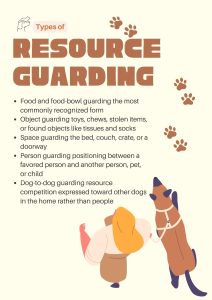
- Food and food-bowl guarding the most commonly recognized form
- Object guarding toys, chews, stolen items, or found objects like tissues and socks
- Space guarding the bed, couch, crate, or a doorway
- Person guarding positioning between a favored person and another person, pet, or child
- Dog-to-dog guarding resource competition expressed toward other dogs in the home rather than people
Do You Need a Professional Dog Trainer for Resource Guarding?
QUICK ANSWER
Mild, early-stage guarding (freezing, stiffening, fast eating) can often be managed at home with consistent trade-up training and management. Growling, snapping, biting, guarding directed at children, or guarding that is getting worse over time should be handled with a certified, force-free professional trainer or behavior consultant.
Signs You Can Start Managing at Home
- Mild stiffening or fast eating with no growling or snapping
- Guarding only occurs with high-value items, not everyday possessions
- The dog readily disengages when called away or offered a trade
- No children, elderly family members, or unfamiliar guests are at risk
Signs You Should Call a Professional Trainer Immediately
- Any growling, snarling, snapping, lunging, or biting
- Guarding directed at children or unfamiliar people
- Guarding that is increasing in frequency, intensity, or the number of triggers
- Multi-dog household guarding that has led to fights
- A dog that guards “randomly” in ways the family can’t predict
Guarding is inherently unpredictable the same item can trigger different responses on different days depending on the dog’s stress level, health, and environment which is exactly why a professional eye is valuable even in seemingly mild cases.
How Professional Dog Trainers Treat Resource Guarding
A qualified trainer doesn’t just “stop” guarding on the surface they change how the dog feels about people approaching their resources in the first place. Punishing a growl only removes the dog’s warning system; it doesn’t remove the underlying discomfort, and it can push a dog from growling straight to biting with no warning at all.
Step 1: Assessment and Trigger Mapping
A trainer identifies exactly which items, locations, people, and contexts trigger guarding, and rates the severity from mild avoidance to fast eating to bite history to build a safe, individualized plan.
Step 2: Desensitization and Counterconditioning
The dog is gradually exposed to a person approaching at a distance the dog can tolerate without reacting, while great things (high-value treats) happen at the same time. Over many short, controlled repetitions, an approaching hand starts to predict good things instead of loss.
Step 3: The Trade-Up Protocol
Instead of taking an item away, the trainer teaches the dog to trade it voluntarily for something equal or better, paired with a reliable “drop it” or “leave it” cue. This is one of the single most effective, evidence-supported pieces of resource-guarding treatment, since owners can use it safely for the rest of the dog’s life.
Step 4: Marker Words and Hand Targeting
Clear marker words (a consistent “yes” the moment the dog makes a good choice) and hand-targeting exercises build cooperative, voluntary engagement, so the dog starts choosing to check in with people instead of guarding against them.
Step 5: Environmental Management
While training is underway, trainers typically recommend removing access to known trigger items, feeding dogs separately in a multi-dog home, and giving the dog a private, undisturbed space for high-value chews management isn’t a cure, but it prevents rehearsal of the guarding behavior and keeps everyone safe during treatment.
How to Choose the Right Dog Trainer for Resource Guarding
The dog training industry is unregulated in most places legally, anyone can call themselves a “dog trainer” with no education or experience requirement. That makes choosing the right person the single most important decision you’ll make in resolving guarding safely. Here’s what to actually check.
Certifications That Signal Real Qualification
No certification is legally required to train dogs, but independent, third-party credentials are the best publicly available signal of real knowledge and an ethical, force-free code of conduct. For resource guarding specifically which carries real bite risk prioritize a trainer with a behavior-focused credential, not just a basic obedience one.
| Credential | Issuing Body | What It Verifies | Best For |
|---|---|---|---|
| CPDT-KA | CCPDT | 300+ hrs experience, exam on learning theory & ethology, code of ethics | General training & mild behavior issues |
| CBCC-KA | CCPDT | 300+ hrs of behavior consulting, exam on aggression/anxiety cases | Resource guarding & aggression |
| IAABC-CDBC | IAABC | Written exam, case studies, LIMA ethics policy | Complex or severe behavior cases |
| KPA-CTP | Karen Pryor Academy | 6-month program, hands-on & written assessments | Clicker-based, positive-reinforcement training |
You can verify any CCPDT credential (CPDT-KA, CPDT-KSA, CBCC-KA) directly through the CCPDT’s public certificant directory before booking a session.
Questions to Ask Before You Hire a Trainer
- Are you certified, and by which organization? Can I verify it independently?
- How many resource-guarding cases have you handled, and what methods do you use?
- Do you use force-free, positive-reinforcement methods, or tools like prong collars, shock collars, or alpha rolls?
- Will training happen in my home, where the guarding actually occurs?
- What does a typical treatment timeline look like for a case like mine?
- What’s your plan if my dog escalates during a session?
- Do you carry liability insurance?
Red Flags to Avoid
- Guarantees to “fix” guarding in one session behavior change takes repetition over time
- Recommends taking items away by force to “show the dog who’s boss”
- Uses punishment, alpha-rolling, or pain-based tools on a guarding dog this is a documented way to suppress the warning growl and increase bite risk
- Offers only board-and-train with no in-home component guarding is tied to specific people and places, so a dog that “behaves” at a facility may not transfer that behavior home
- Can’t or won’t explain their certification or methods clearly
Training Options and Typical Costs
Costs vary significantly by region, session length, and case severity, but the ranges below reflect typical U.S. private and behavior-focused sessions as of 2026.
| Format | What It Involves | Typical Cost Range |
|---|---|---|
| Single private/behavior session | 1-on-1, in-home or virtual, ~60–90 min | $100–$250 per session |
| Multi-session package (4–6 sessions) | Structured desensitization program with follow-up | $500–$900 |
| In-home day training (2–4 weeks) | Trainer works with the dog several times a week plus weekly owner sessions | $1,000–$1,600 |
| Veterinary behaviorist consult | For severe cases needing a full behavioral/medical workup | $300–$500+ per consult |
Severe guarding, guarding involving children, or guarding that co-occurs with generalized anxiety may also benefit from a veterinary behaviorist, who can rule out pain or medical contributors and, when appropriate, discuss behavioral medication alongside training.
What to Do vs. What Not to Do
Do
- Call your dog away from the item rather than approaching to take it
- Trade for something equal or better instead of taking things by force
- Feed and give high-value chews in a separate, undisturbed space
- Teach children never to approach a dog that is eating or has an item
- Work with a certified force-free trainer for anything beyond mild guarding
Don’t
- Punish or scold a growl it removes the dog’s warning system, not the underlying discomfort
- Reach into a bowl or mouth repeatedly to “assert dominance”
- Use a board-and-train program as a substitute for in-home behavior work
- Let a guarding dog rehearse the behavior around unsupervised children
- Assume it will resolve on its own guarding tends to be learned and self-reinforcing rather than something dogs simply outgrow
Frequently Asked Questions
Can puppies outgrow resource guarding?
Some very mild puppy guarding fades with proper socialization and trade-based handling, but guarding that involves growling or snapping is unlikely to resolve on its own and tends to strengthen with age if left unaddressed. Early intervention is far easier than treating an established pattern in an adult dog.
How long does it take to stop resource guarding?
Mild cases can show real improvement in a few weeks of consistent trade-up practice. Moderate to severe cases typically take a structured multi-week program (often 4–8+ weeks) of desensitization and counterconditioning, with management continuing indefinitely, since the goal is a well-managed, safe dog rather than a dog that will never have a resource-related feeling again.
Will resource guarding go away on its own?
Rarely. Because guarding behaviors are self-reinforcing a growl that successfully creates distance gets repeated guarding usually stays the same or worsens without intervention rather than resolving spontaneously.
Is resource guarding the same as general aggression?
No. Resource guarding is trigger-specific (tied to an object, place, or person) rather than a broad aggressive temperament, and it typically responds well to targeted desensitization and counterconditioning rather than requiring treatment for generalized aggression.
When should I call a trainer for resource guarding?
Call a certified trainer or behavior consultant as soon as you see growling, snapping, or biting, or if guarding involves children or is getting worse over time. For milder cases, it’s still worth an initial consult, since a professional can catch early signs an owner might miss and prevent escalation altogether.